

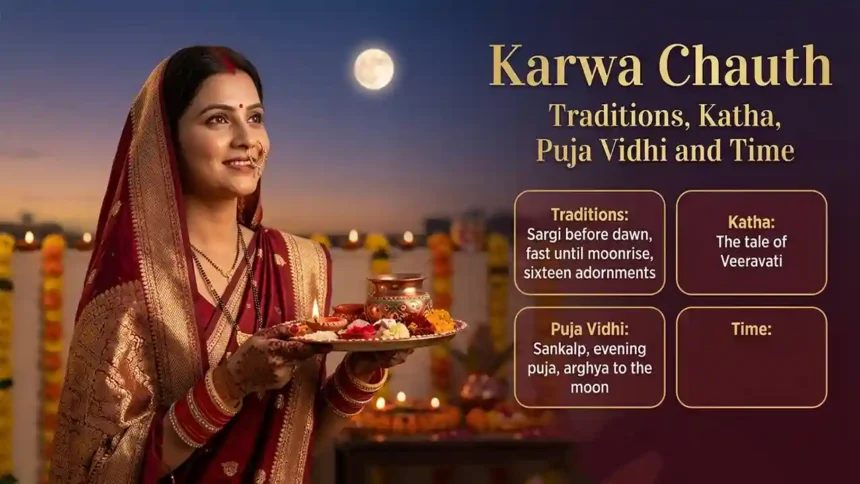
Karwa Chauth Katha, Puja Vidhi, Samagri, Time and Regional Traditions
A complete guide for women observing the fast on Thursday, 29 October 2026
Karwa Chauth is a one-day fast kept on the fourth day (Chaturthi) after the full moon in the month of Kartik, in the Krishna Paksha. Married women traditionally fast from sunrise until they see the moon, praying for their husband’s long life and a happy marriage. This guide covers the date and timings, the katha, the puja step by step, the samagri list, how the festival differs across India, and answers to the questions women ask most.
Karwa Chauth 2026 Time
This year the festival falls on Thursday, 29 October 2026. The timings below are for Delhi. Moonrise differs from city to city, so check your own city’s time before you plan to break the fast.
| Event | Time (IST) |
|---|---|
| Chaturthi tithi begins | About 1:06 AM, 29 October |
| Sargi (pre-dawn meal) | Roughly 4:00 AM to 5:30 AM |
| Fast begins (sunrise) | About 6:31 AM |
| Puja muhurat | 5:38 PM to 6:56 PM |
| Moonrise in Delhi | About 8:11 PM to 8:18 PM (sources differ by a few minutes) |
Note for NRIs: because of the time difference, women in the USA and Canada observe the fast on Wednesday, 28 October 2026. Panchang sources also vary slightly on when the tithi ends, so confirm with your local panchang or family priest.
Karwa Chauth Katha
Several stories are told on this day. The best known is the tale of Veeravati.
The story of Veeravati. Veeravati was the only sister of seven loving brothers. After her marriage she came to her parents’ home for her first Karwa Chauth and began the fast. By evening, hunger and thirst made her faint. Her brothers could not bear to see her suffer, so they lit a fire behind a banyan tree and held a mirror in front of it, and told her the moon had risen. Veeravati believed them, ended her fast and sat down to eat. The first morsel had a hair in it, the second made her sneeze, and before the third she received news that her husband had died.
She rushed to his home, weeping. On the way, Goddess Parvati appeared and told her she had broken the fast before the true moonrise. Parvati asked her to keep the Karwa Chauth fast again with full devotion. Veeravati did so for a year, and her husband was restored to life.
Other stories. Many families also recall Karva, a devoted wife who is said to have saved her husband from a crocodile by binding it with cotton thread, and the legends of Savitri and Satyavan and of Draupadi, who is said to have observed the fast during the Pandavas’ troubles. Versions differ from village to village, which is part of the festival’s charm.
Karwa Chauth Samagri (Puja Items)
Keep everything ready the day before so the evening is calm.
- Karwa (clay or brass pot with a spout) with a lid, filled with water or rice
- Puja thali with roli, kumkum, haldi, akshat (unbroken rice), sandalwood paste
- Diya, ghee or oil, cotton wicks, incense sticks, camphor
- Sieve (chhalni) to view the moon and then the husband
- Solah shringar items: sindoor, bindi, bangles, mehendi, mangalsutra, toe rings, alta
- Karwa Chauth calendar or picture showing Gauri, Shiva, Ganesha and Karthikeya, or idols of Gauri and Ganesha
- Flowers, fruits, a coconut, betel leaves and a few coins
- Sweets and baya (mathri, laddu, halwa, dry fruits, a set of bangles and a saree or cloth for the mother-in-law)
- Water and a sweet for breaking the fast
- A red thread (mauli) and dhaga to tie around the karwa
Karwa Chauth Puja Vidhi (Step by Step)
- Before sunrise: Wake up, bathe and eat the sargi, the meal traditionally sent by the mother-in-law. It usually has fruit, dry fruits, sweets, fenia or mathri and tea or milk. Drink water, then take the sankalp (resolve) to observe the fast.
- During the day: Stay away from food and drink, rest, and spend time in prayer. Avoid arguments and day-time sleep. Mehendi and getting ready are a happy part of the day.
- Afternoon: Set up the puja space. Draw or place the Karwa Chauth picture on a clean wall or chowki, and place the filled karwa in front of it. Women often gather in a group with their thalis.
- Dress for the puja: Wear red, maroon, pink or other bright colours and put on your solah shringar.
- Puja time (5:38 PM to 6:56 PM): Light the diya. Worship Lord Shiva, Goddess Parvati, Lord Ganesha and Lord Karthikeya. Offer roli, rice, flowers, fruits and sweets. Apply tilak to the karwa and tie the mauli.
- Listen to the katha: Sit in a circle. Each woman holds her thali, and the story is read or told. Pass the thali around the circle seven times while singing the traditional song, then exchange karwas with the woman next to you.
- Offer the baya: Give the baya to your mother-in-law or an elder woman and touch her feet for blessings.
- Moon sighting: After moonrise, place a diya in the sieve. Look at the moon through it, offer water (arghya) and pray, then look at your husband through the same sieve.
- Breaking the fast: Your husband gives you the first sip of water and the first bite of food. Then you can eat a full meal.
How Karwa Chauth Differs Across India
The core idea of fasting for a husband’s wellbeing stays the same, but the details change with region and family.
Customs vary between families even within one region, so follow what your family has always done.
Frequently Asked Questions
Can unmarried girls keep Karva Chauth?
Yes. Traditionally the fast is for married women, but engaged women and many unmarried girls also observe it, praying for a good life partner or for a fiancé’s wellbeing. There is no strict rule against it, and it is a personal choice. Many families also see it as a way of showing devotion and love.
Is Karwa Chauth without water?
The traditional form is nirjala: no food and no water from sunrise until moonrise. It is not required for everyone. Women who are pregnant, nursing, diabetic, elderly or unwell, and anyone on medication, should speak to a doctor first. Many keep a gentler version, with water, juice, coconut water or fruit. Devotion matters more than strictness, and your health comes first.
Why do girls do Karwa Chauth?
The main reason is faith: women pray for their husband’s long life, health and a happy marriage, following stories like that of Veeravati. Many also enjoy the festival’s community side, with friends and family dressing up, applying mehendi and celebrating together. For many couples it has become a day to express love and gratitude.
What is Karwa Chauth celebrated for?
It celebrates marital bonds and the wellbeing of the husband. The festival falls in Kartik, around the time of the wheat sowing season in North India. Some folk accounts link it to the custom of women’s friendships, where brides exchanged karwas and became “god-sisters” (kangan sakhi) when they moved to a new village. That origin is an interpretation rather than a documented fact.
Do we wash hair on Karwa Chauth?
Bathing and washing hair in the morning, before the sargi and the puja, is common and considered good, since you start the day clean. Many families avoid washing or cutting hair later in the day, after the puja, and especially after the fast begins. Some families also avoid washing hair on the day itself. Follow the custom of your household.
What is not allowed in Karwa Chauth?
Customs differ, but these are commonly avoided:
- Eating or drinking between sunrise and moonrise (unless your health requires it)
- Sleeping during the day
- Using scissors, needles or knives, and cutting hair or nails
- Arguments, harsh words and gossip
- Breaking the fast before the moon is actually visible
- Eating onion, garlic or non-vegetarian food in the sargi and after the fast, in many households
Which color to avoid on Karwa Chauth?
Avoid black and white. They are considered inauspicious for a festival linked to marriage. Many families also avoid grey, dark blue and very dull shades. Red, maroon, pink, orange, yellow, green and gold are seen as lucky.
What is allowed to eat during Karwa Chauth?
Before sunrise, the sargi: fruits, dry fruits, coconut, sweets, mathri, paratha, fenia, milk or tea, and plenty of water. Foods with some protein and fibre, such as dry fruits, oats or sprouts, keep you full for longer. From sunrise to moonrise nothing is eaten in the strict fast. After moonrise, you begin with water and a sweet from your husband, then a light, home-cooked vegetarian meal.